where: - \(w\) is the weight in
asset 1 (so \(1-w\) is the weight in
asset 2) - \(\mu_1, \mu_2\) are the
expected returns - \(\sigma_1,
\sigma_2\) are the standard deviations - \(\rho_{12}\) is the correlation between the
two assets
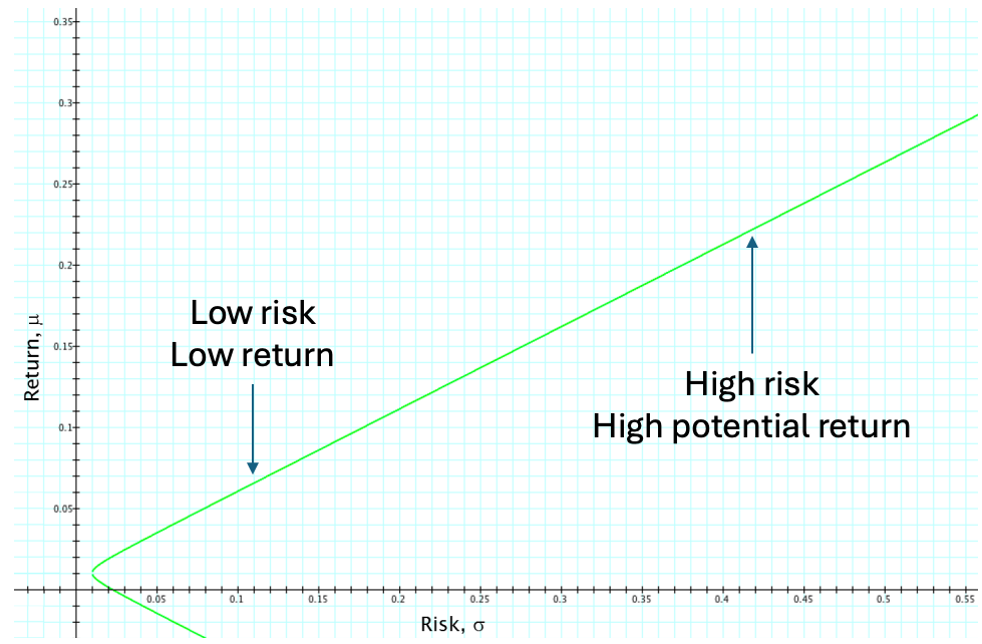
The efficient frontier consists of the portfolios on
the upper branch of this curve—those with the highest expected return
for a given level of risk.
Two-asset Efficient
Frontier
Each point corresponds to a value of \(w\) (the weight in asset 1).
The upper part of the curve is
efficient—these portfolios offer the best return for a
given risk.
The lower part of the curve is
dominated—there are always better choices
available.
The endpoints correspond to holding 100% of one
asset (either asset 1 or asset 2).
Diversification (choosing \(0 < w < 1\)) improves the risk-return
trade-off compared to holding a single asset.
Conditions for the Efficient
Set
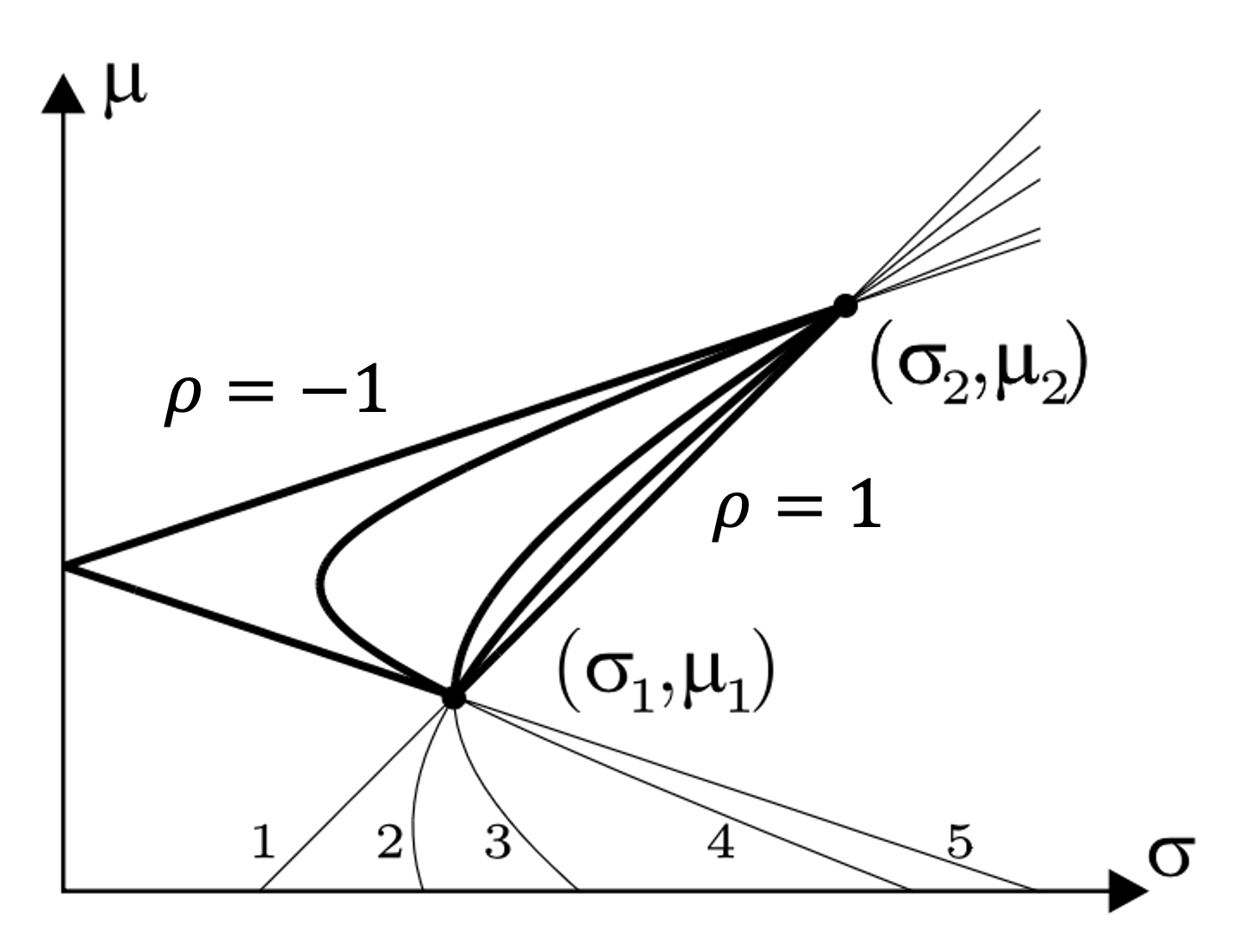
The conditions for the efficient set (relative to asset 1) are:
If \(\frac{\sigma_1}{\sigma_2} <
\rho_{12} \leq 1\), then there exists a portfolio with
short selling such that \(\sigma_V
< \sigma_1\), but for each portfolio without short
selling\(\sigma_V \geq
\sigma_1\) (lines 1 and 2).
If \(\rho_{12} =
\frac{\sigma_1}{\sigma_2}\), then \(\sigma_V \geq \sigma_1\) for each portfolio
(line 3).
If \(-1 \leq \rho_{12} <
\frac{\sigma_1}{\sigma_2}\), then there exists a portfolio
without short selling such that \(\sigma_V < \sigma_1\) (lines 4 and
5).
These conditions describe when diversification can reduce risk below
that of the less risky asset, depending on the correlation and the
possibility of short selling.
Minimum Variance Portfolio
(MVP)
The Minimum Variance Portfolio (MVP) is the
portfolio with the lowest possible risk (variance) for given assets.
This gives the unique portfolio with the lowest possible variance for
two assets.
How?Minimize\(\sigma_V^2\) subject to \(w_1 + w_2 = 1\).
Derivation Using the
Lagrangian
Suppose we have two assets with weights \(w_1\) and \(w_2 =
1 - w_1\). The portfolio variance is: \[
\sigma_V^2 = w_1^2 \sigma_1^2 + (1-w_1)^2 \sigma_2^2 +
2w_1(1-w_1)\rho_{12}\sigma_1\sigma_2
\]
We want to minimize\(\sigma_V^2\) subject to \(w_1 + w_2 = 1\).
Lagrangian Setup
Let \(\lambda\) be the Lagrange
multiplier: \[
\mathcal{L}(w_1, w_2, \lambda) = \sigma_V^2 - \lambda(w_1 + w_2 - 1)
\]
But since \(w_2 = 1 - w_1\), we can
write everything in terms of \(w_1\):
\[
\mathcal{L}(w_1, \lambda) = w_1^2 \sigma_1^2 + (1-w_1)^2 \sigma_2^2 +
2w_1(1-w_1)\rho_{12}\sigma_1\sigma_2 - \lambda(w_1 + (1-w_1) - 1)
\]
The constraint simplifies to \(w_1 + w_2 -
1 = 0\), which is always satisfied.
Take the Derivative
Set the derivative with respect to \(w_1\) to zero: \[
\frac{\partial \mathcal{L}}{\partial w_1} = 2w_1\sigma_1^2 -
2(1-w_1)\sigma_2^2 + 2(1-2w_1)\rho_{12}\sigma_1\sigma_2 = 0
\]
Expand and solve for \(w_1\): \[
2w_1\sigma_1^2 - 2\sigma_2^2 + 2w_1\sigma_2^2 +
2\rho_{12}\sigma_1\sigma_2 - 4w_1\rho_{12}\sigma_1\sigma_2 = 0
\]
For \(\rho_{12} < 1\), this
condition is always satisfied unless the assets are perfectly positively
correlated and have identical volatilities. Thus, the solution above
gives the minimum variance.
Derivation: Efficient Set
Conditions
To determine when diversification reduces portfolio risk below that
of the less risky asset, analyze the portfolio variance:
By design, \(\sigma_1 <
\sigma_2\). This implies \(\frac{\sigma_1}{\sigma_2} <
\frac{\sigma_2}{\sigma_1}\). So, the prevailing condition is:
\[
\rho_{12} < \frac{\sigma_1}{\sigma_2}
\]
Summary of Conditions
If \(\rho_{12} <
\frac{\sigma_1}{\sigma_2}\): There exists a portfolio
(without short selling) with risk less than \(\sigma_1\).
If \(\rho_{12} =
\frac{\sigma_1}{\sigma_2}\): The minimum risk equals
\(\sigma_1\); no further reduction is
possible.
If \(\rho_{12} >
\frac{\sigma_1}{\sigma_2}\): Diversification cannot
reduce risk below \(\sigma_1\) without
short selling.
These conditions define when the efficient set includes portfolios
with risk lower than the least risky asset, depending on correlation and
asset volatilities.
Derivation:
Efficient Frontier Equation for Two Assets
Consider two risky assets with expected returns \(\mu_1\), \(\mu_2\), standard deviations \(\sigma_1\), \(\sigma_2\), and correlation \(\rho_{12}\). Let \(w\) be the weight in asset 1, so \(1-w\) is the weight in asset 2.
Portfolio Expected Return
The expected return of the portfolio is: \[
\mu(w) = w \mu_1 + (1-w) \mu_2
\]
Portfolio Variance
The variance of the portfolio is: \[
\sigma^2(w) = w^2 \sigma_1^2 + (1-w)^2 \sigma_2^2 +
2w(1-w)\rho_{12}\sigma_1\sigma_2
\]
Efficient Frontier Equation
To express the efficient frontier, eliminate \(w\) in favor of \(\mu\):
Solve for \(w\): \[
\mu(w) = w \mu_1 + (1-w) \mu_2 \implies w = \frac{\mu(w) - \mu_2}{\mu_1
- \mu_2}
\]